
Class Action Lawsuit Claims Target Falsely Advertises Good & Gather Tuna as Sustainably Caught
Last Updated on March 27, 2026
Kim v. Target Corporation
Filed: March 18, 2026 ◆§ 2:26-cv-02910
A class action lawsuit says that Target falsely advertises its Good & Gather tuna as sustainably caught.
Arkansas Deceptive Trade Practices Act New York General Business Law California Unfair Competition Law New Jersey Consumer Fraud Act California Consumers Legal Remedies Act Michigan Consumer Protection Act Minnesota False Statements in Advertising Act Wisconsin Deceptive Trade Practices Act Massachusetts Consumer Protection Law Connecticut Unfair Trade Practices Act Rhode Island Deceptive Trade Practices Act Washington Unfair Business Practices Act District of Columbia Consumer Protection Procedures Act Hawaii Revised Statues California False Advertising Law
California
A proposed class action lawsuit alleges that Target falsely advertises that its Good & Gather tuna is caught sustainably, despite evidence that the retail giant’s suppliers rely on dangerous fishing practices that threaten marine ecosystems.
Get the latest open class action lawsuits sent to your inbox. Sign up for ClassAction.org’s free weekly newsletter.
The 59-page lawsuit contends that Target deliberately “turns a blind eye” to the dangerous fishing practices used by its tuna suppliers so as to keep up its sustainability claims and promotions, which the case notes are highly marketable to environmentally-conscious consumers.
In particular, the case describes that Target communicates its sustainable seafood harvesting promise to consumers on the back- and front-label promotions found on all of its Good & Gather tuna packages, which relay that the tuna is wild-caught, sustainable and sourced in a way that protects marine life. The purported commitment to sustainability is further reinforced by Target’s accreditation from the Marine Stewardship Council (MSC), depicted as a blue check on the label of every package.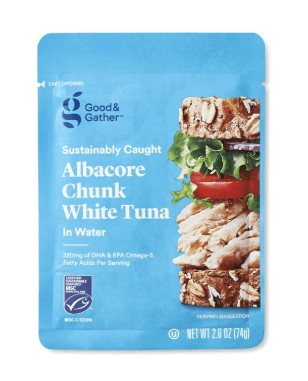
However, the class action lawsuit alleges that Target is aware that the fisheries from which it sources its Good & Gather tuna use harmful fishing methods, and that any representations to the contrary are deceptive and intended to increase the company’s profits by leading consumers to believe that they are making an environmentally conscious purchase.
“Target seeks to have it both ways: pleading ignorance to the harmful practices of the fisheries that source the Tuna Products, while also using the Sustainability Promise to promote the sale of the Tuna Products,” the suit asserts.
Related Reading: Class Action Lawsuit Claims Target Falsely Advertises Good & Gather Veggie Straws
According to the complaint, the fisheries that source Target’s tuna, operating as The Tuna Store LLC and owned by The Bolton Group LLC, rely on two large-scale fishing methods: purse seines and longlines. Purse seines refers to the practice of throwing large nets over a school of fish, and longlines involve the use of a miles-long fishing line equipped with thousands of hooks to catch the targeted species of fish.
The lawsuit argues that these methods of fishing are predisposed to the disruption, unintentional catching, injury and even deaths of thousands of other marine creatures, including “…the suffocation and crushing of dolphins caught in fishing nets that are then hauled onto fishing boats while severely injured or dead; the torturously slow death of endangered sea turtles after getting caught on large hooks meant for haddock; and the entangling of critically endangered whales by fishing gear causing deep wounds and intense suffering,” the case reads.
Related Reading: Bumble Bee Falsely Advertises Tuna, Salmon Products as ‘Sustainable,’ Class Action Says
Furthermore, the lawsuit contends that any certifications offered by the MSC for Target’s suppliers are practically meaningless due to the organization’s “seriously undermine[d]” credibility.
The case charges that these certifications can be effectively “rushed” or bought by fisheries, as the MSC charges retailers 0.5 percent net wholesale value as a royalty fee for using its label, and the organization has rarely denied an applicant in the last 20 years.
“Experts are concerned, and Target is aware, or should have been aware, of this concern, that the rapid growth of the MSC and the inherent conflict of interest involved with its operations have influenced the MSC to compromise its objective,” the filing relays.
Because Target’s sustainability initiatives are only supervised and enforced internally by the fisheries and their vendors, the suit posits that any “violations” or actions deemed harmful for the environment are much more likely to be ignored, underreported, or otherwise swept under the rug.
Despite the accusations against MSC and Target’s suppliers, Target continues to deceptively market its Good & Gather tuna as sustainably sourced, a claim reiterated further by Target executives who promote environmental consciousness and sustainability as matching consumer demand, according to the suit.
“The lack of transparency, combined with the self-policing nature of the industry allows fish retailers like Target to reap the benefits of harmful fishing practices, all while falsely promising customers that its Tuna Products are sustainably caught,” the complaint summarizes.
The Target class action lawsuit seeks to represent all individuals who, during the fullest time allowed by law, purchased a Good & Gather Tuna product in California, or any state with similar laws, for personal or household use within the applicable statute of limitations period.
The varieties of Good & Gather tuna mentioned in the lawsuit include Good & Gather portable pouch Chunk Light Tuna in Water, portable pouch Lemon Pepper Chunk Light Tuna, portable pouch Albacore Chunk White Tuna in Water, portable pouch Sweet and Spicy Chunk Light Tuna, tinned Solid White Albacore Tuna in Water, and tinned Chunk Light Tuna in Water.
Check out ClassAction.org’s lawsuit list for current class action lawsuits.
Video Game Addiction Lawsuits
If your child suffers from video game addiction — including Fortnite addiction or Roblox addiction — you may be able to take legal action. Gamers 18 to 22 may also qualify.
Learn more:Video Game Addiction Lawsuit
Kratom 7-OH Lawsuits
Anyone who has used 7-OH kratom products and suffered a serious injury, such as overdose, heart attack or addiction, may be able to take legal action.
Read more: Kratom 7-OH Lawsuits
How Do I Join a Class Action Lawsuit?
Did you know there's usually nothing you need to do to join, sign up for, or add your name to new class action lawsuits when they're initially filed?
Read more here: How Do I Join a Class Action Lawsuit?

Stay Current
Sign Up For
Our Newsletter
New cases and investigations, settlement deadlines, and news straight to your inbox.
Before commenting, please review our comment policy.