
$100M Walmart Settlement Ends FTC, State Attorneys General Lawsuit Over Deceptive Delivery Driver Pay
FTC et al v. Walmart, Inc.
Filed: February 26, 2026 ◆§ 3:26-cv-01655
A $100M Walmart FTC and attorneys general settlement resolves litigation that alleged the retailer misrepresented potential earnings to delivery drivers.
Illinois Consumer Fraud and Deceptive Business Practices Act California Unfair Competition Law Pennsylvania Unfair Trade Practices and Consumer Protection Law North Carolina Unfair and Deceptive Trade Practices Act Michigan Consumer Protection Act Oklahoma Consumer Protection Act South Carolina Unfair Trade Practices Act Federal Trade Commission Act Arizona Consumer Fraud Act Colorado Consumer Protection Act Wisconsin Deceptive Trade Practices Act Utah Consumer Sales Practices Act California False Advertising Law Gramm-Leach Bliley Act
California
Walmart has agreed to a $100 million settlement to resolve allegations from the Federal Trade Commission and the attorneys general of 11 states that the retail giant made false representations to delivery drivers about the base pay, tips and incentive rewards they could earn.
Get class action lawsuit and class action settlement news sent to your inbox – sign up for ClassAction.org’s free weekly newsletter.
In a February 26, 2026 press release, the FTC announced that Walmart had agreed to a proposed consent order that covers all individuals in the United States and its territories who accepted an offer to shop for and/or deliver goods in connection with the Spark driver program.
Per the consent order, Walmart is required to implement an earnings verification program to ensure that drivers are paid the exact amount shown on an initial offer card. Walmart must also document the results of the earnings verification program and designate a qualified employee to oversee the program, the order states.
Additionally, the order stipulates that Walmart is prohibited from modifying an offer after a driver accepts it, unless to increase tips or other earnings. The order makes an exception for circumstances in which a driver fails to make the delivery or the order is cancelled outright.
Finally, the order precludes Walmart from misrepresenting earnings or other pertinent information displayed on offer cards shown to drivers, including distance, estimated time, the number of stops, or the amount of expected earnings.
In addition to injunctive relief, Walmart must pay $16,175,301 million into a compensatory fund for delivery drivers to reimburse them for any earnings, tips or incentive payments that were shown in an initial offer card between January 1, 2021 and the date of final approval of the settlement but were not paid out to the driver.
Related Reading: $3.79M D.C. Attorney General Settlement Ends Litigation Over Alleged Title Company Kickback Scheme
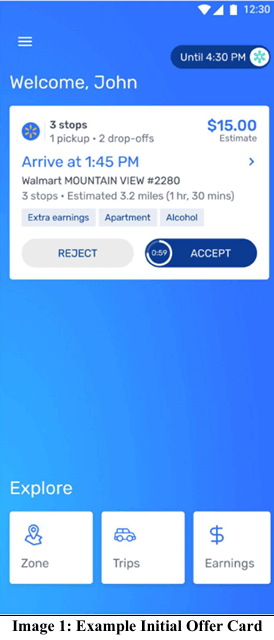
The FTC and the attorneys general from Arizona, California, Colorado, Illinois, Michigan, North Carolina, Oklahoma, Pennsylvania, South Carolina, Utah and Wisconsin said in the initial complaint that Walmart launched the Spark program as a way to attract and use “gig-economy” delivery drivers to deliver curbside pickup orders, shop for customers, or make returns to a nearby store. According to the lawsuit, delivery drivers can view and accept delivery offers directly in the Spark app, which displays an “initial offer card” with the driver’s expected earnings, the number of stops, estimated distance, and the time limit for the delivery.
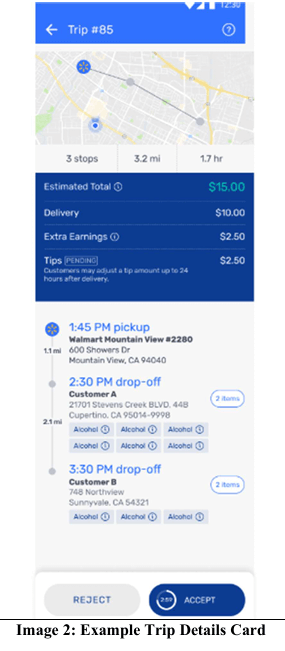
The “trip details card,” which appears after a driver clicks a blue arrow at the bottom of the offer, further breaks down the driver’s expected earnings into a base pay amount, any applicable incentive earnings, and the pre-delivery tip chosen by the consumer, the case states.
Walmart has publicly acknowledged that a driver’s potential earnings are a “primary component” of the decision to accept a delivery job, and that both base pay and tips are “preeminent” in their minds. Unfortunately, the case contended that this knowledge failed to prevent any of the myriad ways in which Walmart was alleged to have pocketed money from its delivery drivers.
As explained in the Spark lawsuit, Walmart frequently broke single-customer orders into multiple deliveries made by different drivers, referred to as a “split” order. After the deliveries are completed, Walmart would then split the tip amount between the drivers. Drivers, however, were not notified when a delivery was part of a split order, and Walmart falsely represented that they would receive the entire tip, the case alleged.
The filing similarly charged that Walmart misrepresented driver earnings and tips with “batched” orders, or multiple customer orders fulfilled in one trip. The lawsuit said that Walmart showed drivers the predicted earnings, including tips, for each batched offer without disclosing that they may be inaccurate due to order modifications and removals.
In those cases, Walmart “fail[ed] to update the initial offer card to reflect the reduced earnings estimate,” and a driver subsequently may have accepted a batched offer in reasonable reliance on expected tip earnings but ultimately received much less than they expected, the lawsuit contended.
Walmart also shortchanged drivers on base pay, calculated based on several factors such as gas and mileage, the case said. Similar to batched orders, split orders, or orders where tip funds are not secured when base pay for a delivery job changes, drivers were not notified until the trip was completed, the suit said.
Walmart also allegedly failed to honor the incentive offers it showed to drivers on the Spark app. The case said drivers were not informed of all the offer’s conditions and were often left frustrated and confused when they didn’t receive their rightfully earned money because they did not fulfill an arbitrary and undisclosed requirement, such as completing deliveries in a particular zone or store.
Moreover, beginning in July 2021 Walmart began misrepresenting pre-tips in offers to drivers by displaying tips that the company did not even collect from consumers, the case charged. The filing asserted that, “by design,” when consumers place a delivery order through Walmart, the retailer only pre-authorizes the amount of the order itself, not the tips for delivery drivers; consequently, drivers have no guarantee that the tip amount from the offer card will be made available to them.
“Walmart did not want to risk losing a sale…so it chose to secure its own funds while leaving drivers,” the case alleged, and did not notify drivers in the event of “tip failure.” Instead, the lawsuit claimed that Walmart surreptitiously changed the displayed pre-tip amount to $0, in direct contradiction with the accepted offer cards, when drivers viewed their completed delivery details.
Importantly, the lawsuit contended that Walmart attempts to pass the blame for its actions to its own customers. The case said that when Walmart fails to preauthorize or secure tip funds, and the tip is uncollected, drivers are shown a page that says, “[T]ips in this delivery were adjusted by the customer after delivery,” implying that the consumer who placed the order is to blame.
The case said that instances in which a consumer reduces a driver’s tip after an accepted offer or delivery are known as “tip-baiting,” and Walmart was allegedly happy to let drivers believe they were victims of the practice.
Tip-baiting, the lawsuit pointedly added, only occurs in 0.04 to 0.09 percent of Walmart delivery orders, per the company’s own internal documents, and yet Walmart’s deceptive and unfair practices lead drivers to believe consumers are responsible.
Adding insult to injury, the case alleged, Walmart repeatedly informed consumers that “100%” of a delivery tip went to the driver, when there was no guarantee the driver would ever see the money.
Are you owed unclaimed settlement money? Check out our class action rebates page full of open class action settlements.
Video Game Addiction Lawsuits
If your child suffers from video game addiction — including Fortnite addiction or Roblox addiction — you may be able to take legal action. Gamers 18 to 22 may also qualify.
Learn more:Video Game Addiction Lawsuit
Kratom 7-OH Lawsuits
Anyone who has used 7-OH kratom products and suffered a serious injury, such as overdose, heart attack or addiction, may be able to take legal action.
Read more: Kratom 7-OH Lawsuits
How Do I Join a Class Action Lawsuit?
Did you know there's usually nothing you need to do to join, sign up for, or add your name to new class action lawsuits when they're initially filed?
Read more here: How Do I Join a Class Action Lawsuit?

Stay Current
Sign Up For
Our Newsletter
New cases and investigations, settlement deadlines, and news straight to your inbox.
Before commenting, please review our comment policy.