
Veterans United Home Loans Illegally ‘Steers’ Veterans into Predatory Loans, Class Action Lawsuit Alleges
Peyton, et al. v. Veterans United Home Loans, et al.
Filed: February 18, 2026 ◆§ 2:26-cv-04039
A class action lawsuit alleges that Veterans United Home Loans illegally steers veterans into predatory home loans through deception, referrals and kickbacks.
A proposed class action lawsuit alleges that Veterans United Home Loans intentionally steers unwitting servicemembers and veterans into predatory, high-interest mortgages by way of outright deception, unlawful referrals and kickbacks to preferred real estate agents.
Want to stay in the loop on class action lawsuits that matter to you? Sign up for ClassAction.org’s free weekly newsletter.
The 42-page false advertising lawsuit asserts that Veterans United Home Loans has “capitalized on and exploited” the high demand for mortgages from active military members and veterans by falsely presenting itself as part of the Veterans Administration (VA). In reality, the suit says, Veterans United is a private, for-profit mortgage company with no affiliation with the federal government whatsoever.
The filing states that Veterans United has intentionally designed its website with large, attention-grabbing text that purports that the company is “The Nation’s #1 VA Lender.” The only disclaimer stating otherwise is in tiny, low-contrast text at the bottom of the page, the case says.
The lawsuit states that servicemembers and veterans are often unaware that the services offered by the defendant are not associated with the VA. As a result, a common misconception among military servicemembers and veterans is that they must use Veterans United for their mortgages, the case says, adding that real estate and loan officers have claimed to “routinely lose business” to Veterans United due to the company positioning itself as “part of” the VA.
Further, the filing says that Veterans United wields a “fleet” of preferred real estate agents across the country who do not directly work for the company, but receive referrals, or “leads,” from the mortgage lender.
Per the complaint, Veterans United agent agreements require sales agents to steer veterans towards using the company for their home loans, and, per the agreement, the defendant receives about 35 percent of an agent’s commission fee upon loan closing.
In return, the case says, Veterans United continues to provide referrals to the agents in exchange for “pushing” clients toward the private mortgage lender’s allegedly predatory loans, in violation of the Real Estate Settlement Procedures Act (RESPA).
If agents do not continually refer clients to Veterans United, their commissions dry up, the suit says; if they successfully steer clients to the defendant, their referrals increase, the case mentions. The lawsuit contends that this arrangement constitutes a clear breach of agents’ fiduciary duties, which require agents to act in clients’ best interests.
Included in the complaint is a diagram that explains Veteran United’s alleged circular system of referrals and kickbacks: 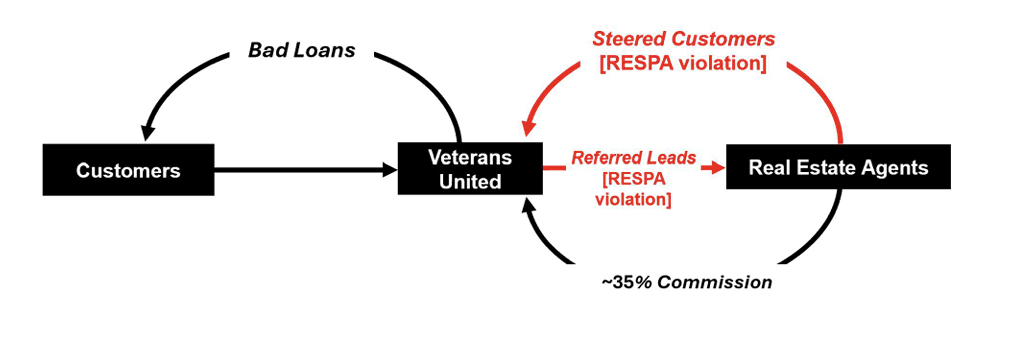
The allegedly unlawful referrals are never disclosed to clients and amount to “blatant steering,” often to the detriment of active military members and veterans who could find more competitive pricing with other mortgage lenders, the class action lawsuit says.
The lawsuit states that Veterans United loan options are “much more” expensive than alternatives, including the loans’ fees, costs, and higher interest rates, which one anonymous loan officer interviewed for the case referred to as a “significant disservice” to active military members and veterans, who often lack the capital to cover these costs.
Another anonymous loan officer quoted in the filing said that they often saw clients using Veterans United who had “become confused and frustrated based on unclear explanations, inconsistent information,” and who received no “meaningful” help from the lender on how to qualify for a home loan under VA guidelines.
In fact, the case claims, Veterans United often fails to even provide the mortgages servicemembers and veterans are seeking; a “recurring issue” is that the lender tells veterans they do not qualify for a loan, and the loan was “stopped” with no additional guidance, the complaint says.
“[Veterans United] engaged in patently unfair and deceptive behavior and obtained a windfall of ill-gotten gains as a result,” the case charges.
The Veterans United Home Loans class action lawsuit seeks to cover all individuals and entities in the United States who, from January 1, 2020 to the present, used Veterans United Home Loans to finance the purchase of a property.
Check out ClassAction.org’s lawsuit list for the latest open class action lawsuits and investigations.
Video Game Addiction Lawsuits
If your child suffers from video game addiction — including Fortnite addiction or Roblox addiction — you may be able to take legal action. Gamers 18 to 22 may also qualify.
Learn more:Video Game Addiction Lawsuit
Kratom 7-OH Lawsuits
Anyone who has used 7-OH kratom products and suffered a serious injury, such as overdose, heart attack or addiction, may be able to take legal action.
Read more: Kratom 7-OH Lawsuits
How Do I Join a Class Action Lawsuit?
Did you know there's usually nothing you need to do to join, sign up for, or add your name to new class action lawsuits when they're initially filed?
Read more here: How Do I Join a Class Action Lawsuit?

Stay Current
Sign Up For
Our Newsletter
New cases and investigations, settlement deadlines, and news straight to your inbox.
Before commenting, please review our comment policy.