
Class Action Lawsuit Alleges MatchaBar ‘Ceremonial Grade’ Matcha Powder Is Lower Quality Than Advertised
Morris et al. v. Matchabar, Inc.
Filed: April 6, 2026 ◆§ 3:26-cv-2161
A class action lawsuit alleges that MatchaBar falsely advertises its Ceremonial Grade Matcha Powder as being of the highest quality.
California Unfair Competition Law California Consumers Legal Remedies Act California False Advertising Law
California
MatchaBar, Inc. is staring down a proposed class action lawsuit that alleges its Ceremonial Grade Matcha Powder is low quality and not fit for use in a Japanese tea ceremony as advertised.
Get class action lawsuit and class action settlement news sent to your inbox – sign up for ClassAction.org’s free weekly newsletter.
The 24-page false advertising lawsuit contends that MatchaBar, which represents that its Ceremonial Grade Matcha Powder is of such high quality that it is suitable for use in a traditional Japanese tea ceremony, has charged consumers an unwarranted premium price given that its matcha powder is not of the highest grade and quality.
MatchaBar repeatedly emphasizes throughout advertising and marketing materials the purportedly “ceremonial grade” characteristics of its matcha powder, the suit conveys. On the product’s Amazon page, for instance, the company claims that the matcha is “certified ceremonial grade” by a tea master in Kagoshima, Japan who supposedly has a tenth-level “tea master,” or “chashi,” certification. Per the suit, marketing materials further claim that the company works to “craft the smoothest ceremonial grade matcha in the world.”
According to the class action lawsuit, Japanese tea ceremonies, or “sa-dou,” use matcha, a powdered green tea, that is grown and harvested in accordance with “strict” rules and a “laborious and exacting” production process, and due to the rigorous standards involved in its production, is one of the “most expensive” teas on the market, the filing says.
The suit explains that high-quality matcha powder is made with the top three layers of young tea plants that have been shade-grown and contain higher levels of chlorophyll, which gives high-quality matcha its characteristic striking green color. After the leaves are harvested, they are steamed, deveined and ground in stone mills, the case says.
Matcha is evaluated based on five criteria, the filing explains, including color, particle size, ability to foam, foam color and taste. High-quality matcha is a “vivid” bright green color with fine, uniform particles that produce “abundant” green foam and give the tea a “complex and deep” aroma and taste with a “dissolved” mouthfeel, the lawsuit says.
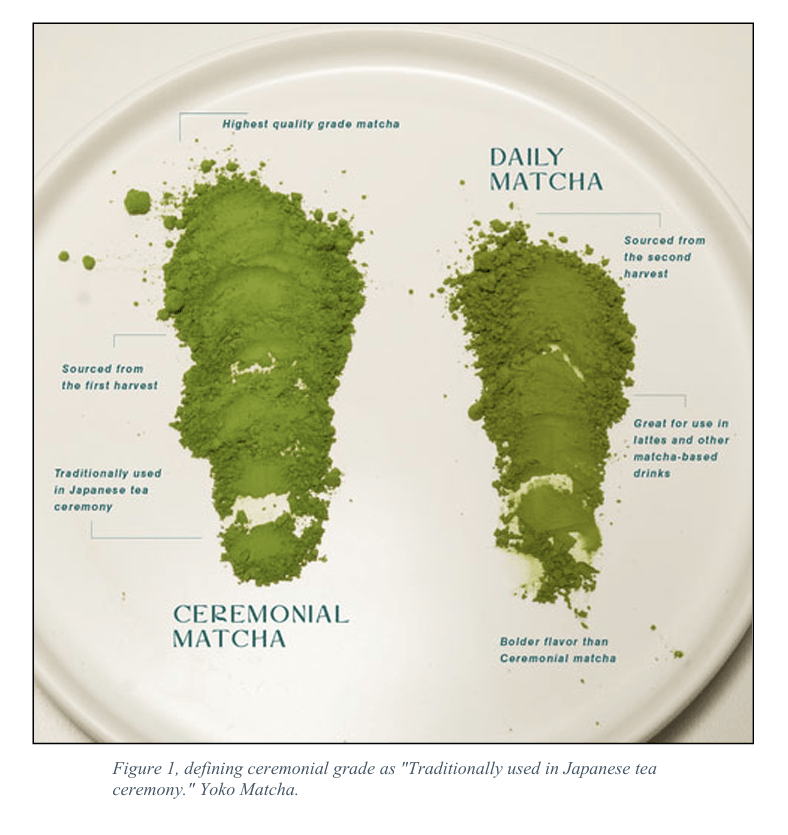 By contrast, low-quality matcha tends to be marked by “bluish-black,” white-washed, reddish-brown or yellowish hues, with uneven grainy particles that foam poorly, which the case says creates a gritty mouthfeel with a “grassy or raw” aroma and a burnt, bitter taste.
The filing says that while the term “ceremonial grade” is not used for matcha in Japan, matcha producers and Western media sources such as Bon Appetit have used the term to refer to matcha of the highest possible quality, and consumers “ubiquitously” understand that matcha powders with a ceremonial grade designation are superior and “fit for use” in Japanese tea ceremonies, the suit relays.
Per the complaint, independent testing of the MatchaBar Ceremonial Grade Matcha Powder by a Japanese tea-grading expert using a sensory evaluation method revealed that the matcha powder is of a lower quality than the “ceremonial grade” designation would suggest.
The case says that the expert found that MatchaBar powder would be “unlikely” to be selected for use in an authentic Japanese tea ceremony; the product was allegedly tinged with “a strong yellow hue,” redness and blueish-black tones, suggesting that the tea leaves used were older or not properly shaded as the plant grew, that the chlorophyll had degraded or that there were errors in processing time. Additionally, tea made with the matcha powder lacked the characteristic bright green color of high-quality matcha, the filing states, and the taste was tainted by “bitterness and astringency.”
Had the plaintiffs and class members known that the MatchaBar matcha powder was misleadingly labeled and of a lower quality than a reasonable consumer would expect, they would not have paid the price premium commanded by “ceremonial grade” matcha, the lawsuit states.
The MatchaBar class action lawsuit looks to cover all individuals who purchased at least one of the company’s MatchaBar Ceremonial Grade Matcha Powder products in the United States within the applicable statute of limitations period.
Check out ClassAction.org’s free legal resources to learn how to file a class action lawsuit.
Video Game Addiction Lawsuits
If your child suffers from video game addiction — including Fortnite addiction or Roblox addiction — you may be able to take legal action. Gamers 18 to 22 may also qualify.
Learn more:Video Game Addiction Lawsuit
Kratom 7-OH Lawsuits
Anyone who has used 7-OH kratom products and suffered a serious injury, such as overdose, heart attack or addiction, may be able to take legal action.
Read more: Kratom 7-OH Lawsuits
How Do I Join a Class Action Lawsuit?
Did you know there's usually nothing you need to do to join, sign up for, or add your name to new class action lawsuits when they're initially filed?
Read more here: How Do I Join a Class Action Lawsuit?

Stay Current
Sign Up For
Our Newsletter
New cases and investigations, settlement deadlines, and news straight to your inbox.
Before commenting, please review our comment policy.